A two-sword display can look balanced while hiding an unbalanced setup. One scabbard may be wider, one guard may project farther, and the upper piece may change the stand's center of gravity more than expected. The platform beneath the rack adds visual structure, but it does not eliminate the need to check joints, contact points, tier clearance, and the full loaded footprint.
The Safe Haven Armor Platform Double Sword Stand is listed at $39.99. The product page describes a light-wood, two-tier platform stand with a sleek contemporary design and sturdy construction. It does not publish dimensions, groove width, tier spacing, wood species, padding, load capacity, assembly details, or a universal-fit promise. The safest buying approach is to measure both intended swords and test the stand one load at a time.
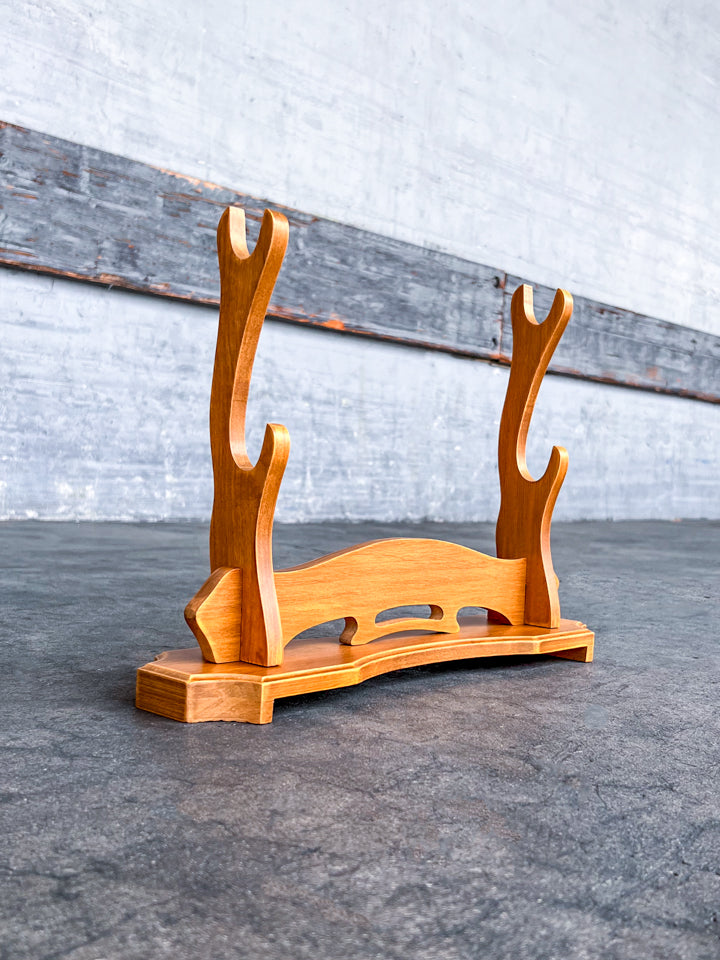
Choose the pair before choosing the location
Two tiers describe capacity, not compatibility. A katana and wakizashi may form a visually natural pair, but two full-size swords can work if their dimensions and fittings clear one another. What matters is the pair you own, not a generic category name.
Measure each sheathed sword in inches. Record overall length, scabbard width at the support point, maximum guard projection, handle length, and any decorative fitting that extends above or below the body. Also compare weight distribution. A heavy handle can shift the combined display forward even when the empty stand sits flat.
Lay painter's tape on a table to represent both sword lengths. Add vertical space for lifting the upper piece without striking the lower one. Add depth for guards and handles, plus room for both hands. If the pair overlaps, rests on fittings instead of scabbards, or requires one sword to be wedged into a groove, ask for current-stock measurements before ordering.
Inspect the platform and joints while the stand is empty
Recent U.S. search results and sword-collector discussions return the same practical concerns: light racks can wobble on an uneven table, uprights can move in loose base slots, and unlined rests can let a scabbard rattle or pick up marks. Positive comments focus on solid construction and a clean finish. Those are physical qualities you can test without inventing a load rating.
Assemble only as directed. Put the empty stand on a known-flat, rigid surface. Press gently at each platform corner, then apply light front-to-back and side-to-side pressure to the uprights. The platform should remain seated and joints should not visibly open. If it rocks, repeat the test on a second level surface before deciding whether the furniture or stand is responsible.
Do not begin with glue, paper shims, sanding, or new hardware. Online discussions may suggest quick fixes, but an improvised repair can hide a manufacturing problem, change fit, or affect return eligibility. Photograph any loose joint, crack, twist, or finish concern before altering the product and contact support for the appropriate next step.
Load the lower tier first and pause
Place the stand on a padded floor or a large, rigid table for its first loaded test. Keep both swords sheathed. Lower the lighter or less top-heavy sword onto the lower tier with two hands. Confirm that it rests on the scabbard rather than the guard, handle wrap, or a decorative fitting. Nothing should be forced into a notch.
Step back and look from the front and side. The stand should remain flat, the sword should not roll, and the scabbard tip should clear the furniture and wall. Gently touch the furniture nearby, not the loaded stand, to see whether normal room movement transfers obvious vibration.
Add the second sheathed sword only after the lower position is predictable. Check the clearance between guards, handles, and scabbards. Remove the upper sword once, using the motion you would use during routine handling. If removal pulls, bumps, or lifts the lower sword, the pair or tier order needs to change. A display that works only when nobody touches it is not a successful setup.
Protect both scabbards at the contact points
The product page does not promise padded rests. Before loading, use clean light and a fingertip to inspect every place where wood may contact a scabbard. Look for dust, burrs, rough finish, glue residue, exposed hardware, or a sharp edge. A small hard point can matter after weeks of static pressure.
If you decide to add a protective layer, use a clean, non-abrasive material compatible with the scabbard finish. Thick felt reduces useful groove depth. Slick material can let a round scabbard move. Adhesive can migrate, stain, or leave residue. Test any addition away from a visible area, keep it clear of the blade and fittings, and inspect it periodically.
Do not let sword oil transfer to the stand, and do not assume furniture polish or household cleaner is safe for the wood finish. Use a dry, soft cloth unless supplied care instructions say otherwise. Displaying swords in their scabbards generally reduces unnecessary exposure and handling risk; follow each sword maker's maintenance guidance.
Plan the room around the loaded width
The platform is only the center of the footprint. Handles and scabbard tips can extend several feet beyond it. Mark the longest loaded width on the intended cabinet with painter's tape. Add hand clearance, depth for guards, and vertical space for lifting the top sword. Open nearby drawers and doors, sit in the adjacent chair, and walk the normal path through the room.
Choose stable furniture that is deep enough for the platform and rated for the total display. Keep the rack away from foot traffic, rolling chairs, slamming doors, speakers, damp walls, direct sun, and heat vents. A platform stand is not a locking system. Never position it above a bed, sofa, frequently occupied desk, or another place where a fall could cause serious harm.
Collector search results often mention the familiar horizontal convention of displaying a sheathed katana with the handle to the left and the edge side up. If that convention matters to you, confirm the intended orientation for each sword and ensure the stand supports it without pressure or instability. Safety, the sword maker's guidance, and the actual geometry of the pair come first.
Use this final decision filter
The Platform Double Sword Stand is a reasonable candidate for two compatible sheathed swords, a stable low-traffic surface, and a collector who wants a contemporary light-wood presentation. It is a poor match when you need adjustable tier spacing, published load data, a locking enclosure, child-resistant storage, or guaranteed fit for unusually broad guards and scabbards.
Before ordering, answer six questions: Do both scabbards fit the expected support points? Do the guards clear one another? Is there enough vertical removal space? Is the furniture flat and deep enough? Can children, pets, or visitors reach the display? Are you comfortable with normal light-wood color variation?
Keep live blades, heavy replicas, and all sharp edges inaccessible to children, pets, and untrained visitors. Follow applicable laws and the makers' handling instructions. For current-stock dimensions, tier spacing, or finish questions, email support@safehavenarmor.com, then review current availability and photos on the Platform Double Sword Stand product page.